


Is a keto-friendly hard seltzer really keto? 12 label, carb & ingredient questions answered
Is a keto-friendly hard seltzer really keto? 12 label, carb & ingredient questions answered
If you have ever stared at a can and thought, is this keto-friendly hard seltzer actually keto, you are in good company. Between tiny nutrition panels, mystery flavours and marketing spin, it can feel like you need a degree in small print. The good news is that once you know what to look for, choosing a crisp, low-carb drink in Australia is surprisingly simple. Today we will break down labels, carbs and ingredients like two mates at the esky, except with less guesswork and more clarity.
In this guide, we will answer twelve of the most asked questions people have about hard seltzers and keto, show you how brewing impacts sugar, and share a quick label checklist that works in any Australian bottle shop. We will also explain how an Australian-brewed coconut water seltzer fits into the picture, because brewed-from-fruit is not the same thing as sweet fruit juice in a can.
For context, Coco Loco Hard Seltzer brews alcoholic drinks from young green coconut water in small batches in Victoria (VIC). The result is a naturally low sugar option, with about 3.6 grams (g) of sugar per can, 100 percent real ingredients and no artificial additives. If you are chasing flavour without the sugar bomb, this is where things get interesting.
What is a keto-friendly hard seltzer, exactly?
Hard seltzer is an alcoholic sparkling water. Brands typically ferment a simple sugar source, filter for a clean base, then finish with bubbles and flavour. Keto-friendly simply means it is extremely low in net carbohydrates, so it fits into a ketogenic or low-carb approach without eating your daily carb budget in one sip. In practice, most people on keto look for zero to around two grams (g) of net carbs per can, clear labels and no hidden syrups.
Here is the big distinction. Fruit-forward flavour is not the same as fruit juice in the can. A keto-friendly hard seltzer gets its alcohol from fermentation, not from pouring in juice at the end. With fermentation, yeast consume sugar and produce ethanol and carbon dioxide (CO2). When the brew is finished and filtered, you are left with minimal residual sugar, a crisp profile and far fewer carbs than a cider or ready-to-drink cocktail.
- Quick rule of thumb: aim for 0 to 2 grams (g) net carbs per can, preferably listed on the can.
- Look for simple, real ingredients, such as fermented coconut water, sparkling water and natural flavour from fruit.
- Check for gluten-free if you are coeliac or gluten-sensitive. Many seltzers are naturally gluten-free.
- Confirm alcohol by volume (ABV) and serving size. Per 100 millilitres (ml) numbers can look tiny, but the can is what you actually drink.
Why does a truly keto-friendly choice matter for you in Australia?
Keto or low-carb goals live and die by the details. Alcohol does not contain carbs itself, yet the sugars that survived fermentation do. Two or three extra grams (g) here and there can nudge you out of your planned macros, particularly if you are keeping daily carbohydrates in the 20 to 30 grams (g) range. On the flip side, choosing a can with minimal residual sugar gives you the experience you want without the carb aftershock. It is about enjoying the moment while keeping your plan intact.
There is also practicality. In Australia, alcoholic drinks over 1.15 percent ABV are often exempt from a full nutrition information panel unless the brand makes a nutrition claim, according to Food Standards Australia New Zealand (FSANZ). That means brands that choose transparency help you make better calls at the shelf. Industry tracking has shown that low sugar and gluten-free options continue to grow year on year nationwide, especially in warmer months, and seltzer demand spikes across coastal regions. In short, there is a reason more Aussies are reading cans closely.
Then there is quality. Coco Loco Hard Seltzer is brewed in Victoria (VIC) in small batches using young green coconut water, which naturally brings trace minerals and a fresh profile to the party. With about 3.6 grams (g) of sugar per can, gluten-free credentials and 100 percent real ingredients, it is built for people who want flavour with far less sugar. The online store has age verification for Adults 18 years and over, mix packs, and delivery perks like free shipping over 120 Australian dollars (AUD) and free next day delivery in eligible areas, plus 10 percent cashback on all orders. Convenience matters when you are planning the week.
How does a brewed coconut water hard seltzer work, from ferment to can?
Let us lift the lid. Fermentation is where the keto-friendly magic happens. Yeast eat sugars from a fermentable base and convert them to alcohol and carbon dioxide (CO2). With coconut water, that base is the natural sugars present in young green coconut water. Well-managed brews are fermented dry, then filtered for clarity, so very little sugar remains. The final product is topped with sparkling water, flavour is added from real sources, and the result is a clean, crisp drink with minimal residual sugar.
Why coconut water as a base? Young green coconut water is lightly mineral, refreshingly neutral and not grain-based. It ferments cleanly, bringing a subtle roundness without heavy sweetness. While fermentation reduces sugar significantly, it does not remove all energy. Alcohol itself carries energy at around 29 kilojoules (kJ) per gram, which is about 7 kilocalories (kcal) per gram. For people counting, that is why you can have a low-carb can that still shows meaningful kilojoules (kJ). Carbs are low, flavour is high, energy comes mostly from the alcohol.
Once you understand this, label reading gets much easier. You are checking for how much sugar survived fermentation, how big the serving is, and whether anything sneaky got added back in. Here is a simple decoder for Australian cans.
| Label claim | What it means in Australia | What to check |
|---|---|---|
| Low carb | Usually signals minimal carbohydrates, often 0 to 2 grams (g) per 330 millilitres (ml) can | Is there a nutrition panel listing carbs or sugar per can, not just per 100 millilitres (ml)? |
| No sugar | May mean zero or less than 0.5 grams (g) per 100 millilitres (ml) depending on rounding | Check for total carbohydrates per can to be safe |
| Gluten-free | Suitable for coeliacs and gluten-sensitive people | Confirm if you are medically sensitive |
| Australian made | Brewed and packed locally | Look for state or region, such as Victoria (VIC) |
| Standard drinks | Shows alcohol content as Australian standard drinks | Cross-check with alcohol by volume (ABV) |
| Natural flavour | Flavour sourced from natural materials | Scan ingredients for fruit extracts rather than syrups |
| Ingredients | Order shows most to least by weight | Watch for glucose syrup, dextrose or fruit concentrate additions |
| Per 100 millilitres (ml) | Regulatory format, can make carb numbers look small | Calculate the total per can for real-world intake |
Curious how seltzers compare to other drinks? Here is a quick, practical comparison using typical Australian serves.
| Drink type | Typical serve | Approx net carbs per serve | Approx energy per serve |
|---|---|---|---|
| Hard seltzer, brewed base | 330 millilitres (ml) can | 0 to 2 grams (g) | 300 to 420 kilojoules (kJ) |
| Vodka soda, spirit-based | 30 millilitres (ml) vodka + 300 millilitres (ml) soda | ~0 grams (g) | 280 to 370 kilojoules (kJ) |
| Full-strength beer | 375 millilitres (ml) bottle | 10 to 13 grams (g) | 540 to 650 kilojoules (kJ) |
| Cider | 330 millilitres (ml) bottle | 20 to 30 grams (g) | 700 to 1,000 kilojoules (kJ) |
| Still wine | 150 millilitres (ml) glass | 1 to 4 grams (g) | 420 to 540 kilojoules (kJ) |
| Ready-to-drink cocktail | 330 millilitres (ml) can | 10 to 25 grams (g) | 600 to 1,100 kilojoules (kJ) |
One more helpful thing is a quick macro walk-through. Imagine a 330 millilitres (ml) can at 4.5 percent alcohol by volume (ABV) with 3.6 grams (g) sugar. Alcohol mass is roughly 330 millilitres (ml) × 4.5 percent × density 0.789 grams (g) per millilitre (ml), which lands around 11.7 grams (g) alcohol. Energy from alcohol is about 11.7 × 29 kilojoules (kJ) per gram (g) equals around 339 kilojoules (kJ). Add sugar energy at 3.6 × 17 kilojoules (kJ) per gram (g) equals about 61 kilojoules (kJ). That is approximately 400 kilojoules (kJ) total. The carbs remain low, the energy largely comes from alcohol. This is illustrative only, since brands vary, but it shows why a can can be low carb yet not low energy.
What should you check on the label to confirm it is keto-friendly?
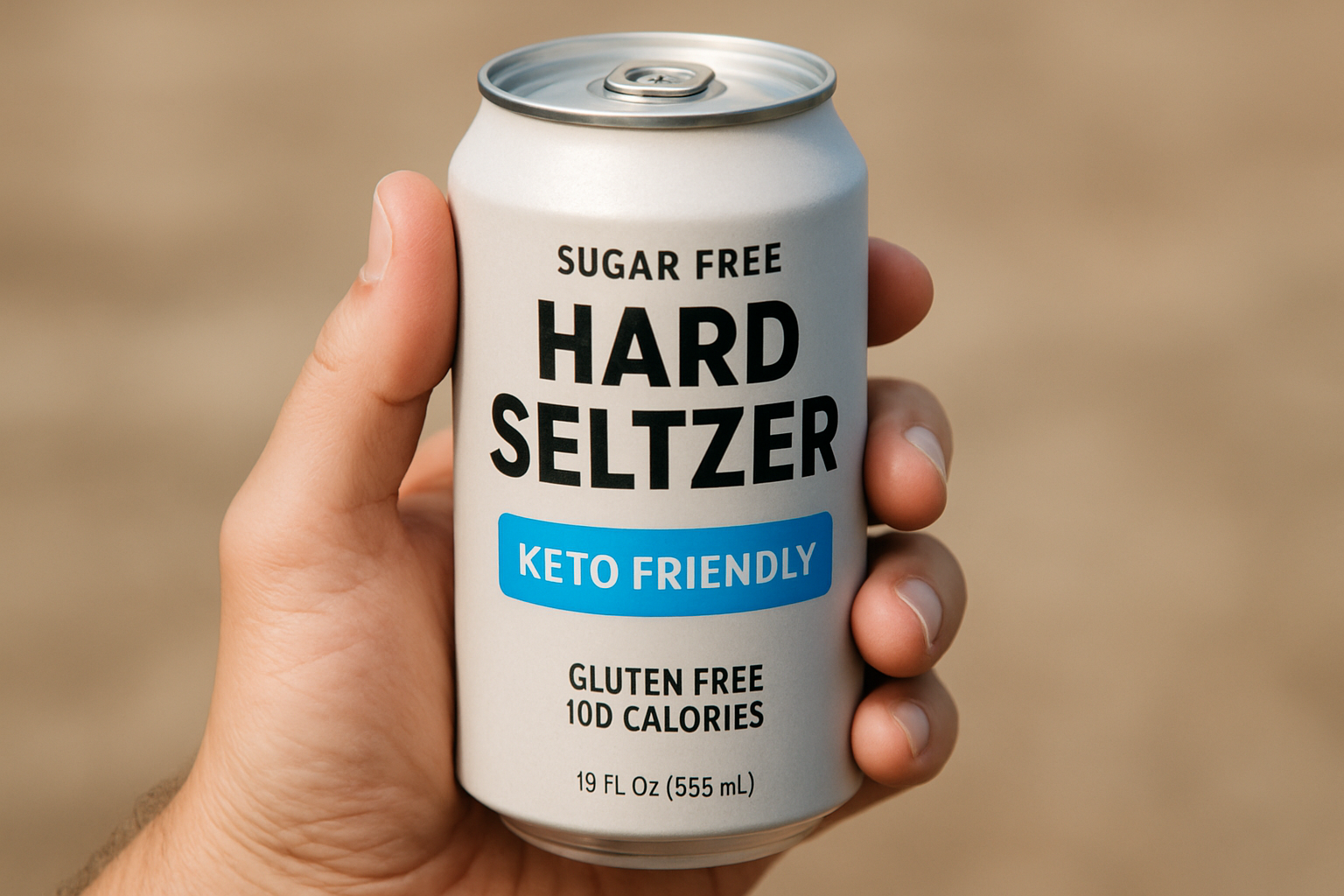
There is a fast three-step check I use when I am in a hurry, because the barbecue waits for no one. First, find carbohydrates and sugar per can. If it is zero to around two grams (g) per can, you are in keto-friendly territory. Second, confirm the serving size matches the full can, not just per 100 millilitres (ml). Third, skim the ingredient list for any sweet syrups or concentrates that could add sneaky carbs.
- Carbs per can: zero to two grams (g) is a safe target for most ketogenic diets.
- Ingredients: fermented base, sparkling water, fruit-derived flavour, nothing artificial if that matters to you.
- ABV: common ranges are 4 to 5 percent. Higher alcohol by volume (ABV) does not add carbs, it adds energy.
- Gluten-free: useful if you are sensitive. It does not make it more or less keto, it makes it more inclusive.
- Australian-made and small-batch: signals freshness and traceability, which many of us prefer.
For Coconut-water-based seltzers, verify that the sweetness is not coming from added juice after fermentation. Coco Loco Hard Seltzer explicitly brews from young green coconut water, then finishes with real flavour. The result is about 3.6 grams (g) sugar per can, gluten-free, with no artificial additives, and that is exactly the sort of label that keeps keto macros tidy.
Common questions: your 12 label, carb and ingredient answers
1) Is zero sugar the same as zero carbs?
Not always. Zero sugar can mean there is less than a certain small amount per 100 millilitres (ml) based on rounding rules, and total carbohydrates can still appear when you scale up to the full can. Always look for total carbohydrate per serving or per can to be sure your net carbs align with your goals.
2) What does net carbs mean on alcohol?
Net carbs are the carbohydrates that impact blood glucose, which for seltzers typically come from residual sugar. Alcohol itself is not a carbohydrate, although it carries energy at around 29 kilojoules (kJ) per gram (g). If a can lists 1 gram (g) carbs and 0 grams (g) fibre or sugar alcohols, your net carbs are essentially 1 gram (g).
3) Can a keto-friendly hard seltzer kick me out of ketosis?
It can, but usually because of total intake, not because a single can has a sneaky carb bomb. Alcohol is prioritised by the liver, which can temporarily slow fat burning and ketone production. If you keep carbs very low per can and pace yourself, most people maintain their goals, but everyone’s metabolism differs, so test and see what your body does.
4) How many grams of carbs per can keeps me on track?
Many keto drinkers set a personal cap of 1 to 2 grams (g) net carbs per can. Even at two cans, you are only spending 2 to 4 grams (g) of your daily budget, which is manageable for lots of ketogenic plans. If you see five or more grams (g) per can, that is drifting into cider territory.
5) Does alcohol by volume (ABV) raise carbs or just energy?
ABV does not add carbohydrates, it adds energy. Alcohol delivers about 29 kilojoules (kJ) per gram (g). So a higher ABV can mean a higher energy count, but your carb tally can still be very low if fermentation has removed most sugar. For keto decisions, check carbs first, then consider ABV for pacing.
6) Brewed vs spirit-based seltzer, which aligns better with keto?
Both styles can be keto-friendly. A brewed hard seltzer uses fermentation for the alcohol and, when fermented dry, leaves very little residual sugar. A spirit-based seltzer is basically a vodka plus soda with flavour, which is also typically zero carb. The difference is in mouthfeel and flavour. Brewed coconut water bases bring a gentle roundness without sweetness, which many of us enjoy.
7) Do sugar alcohols and non-nutritive sweeteners count?
It depends on the product and your personal response. Many hard seltzers do not use sugar alcohols at all, and Coco Loco Hard Seltzer focuses on real ingredients with no artificial additives. If a can uses stevia or similar, carbs are usually still very low. Some people find sweeteners increase cravings, so adjust to your experience.
8) Are natural flavours and concentrates a red flag?
Natural flavours are fine when used to finish a dry-fermented base. Concentrates can be a red flag if they are added for sweetness rather than flavour, since they can bump up carbs. Read the sequence of the ingredient list and, if in doubt, trust the carbohydrate number per can as your anchor.
9) What should I know about serving size and panels in Australia?
Alcoholic drinks above 1.15 percent ABV are often exempt from a full nutrition information panel unless a nutrition claim is made, according to Food Standards Australia New Zealand (FSANZ). Many brands still list sugar or carbs. Watch for per 100 millilitres (ml) tiny numbers and multiply by the can volume so you are measuring what you are actually drinking.
10) Do electrolytes from coconut water survive brewing?
Fermentation changes the base, so you will not get a sports drink in a can, and that is not the goal anyway. Some trace minerals from young green coconut water can remain, contributing to the clean profile. If you want electrolytes, pair your seltzer with a mineral water or a salt-forward snack and you will be sorted.
11) How do I mix or garnish without adding carbs?
Keep it simple. Citrus zest, fresh herbs like mint or basil, cucumber ribbons, or a squeeze of lime are basically zero carb moves. Coco Loco Hard Seltzer shares ideas on the Coco Loco Journal recipes page, and the Cocktail Spritz, Piña Colada Spritz and Passioná Spritz flavours make great bases with no need for sweet mixers.
12) Where can I buy an Australian-made option that fits these rules?
Online is easiest. Coco Loco Hard Seltzer is Australian-made in Victoria (VIC), naturally low sugar at about 3.6 grams (g) per can, gluten-free and brewed with 100 percent real ingredients. The store has age verification for Adults 18 years and over, mix packs, free shipping over 120 Australian dollars (AUD), free next day delivery in eligible areas and 10 percent cashback on all orders. Eco packaging and customer reviews round it out, so you can click add to cart and get on with your weekend.
What is the smart way to enjoy keto-friendly hard seltzer socially?
Think of it as a friendly three-step rhythm. Start cold and slow, sip, then swap to water. Snack on protein or olives so you are not accidentally grazing on chips. Most people find a pace of one can per hour with water between keeps energy and social fun in balance, especially under Australian sun, where it is easy to forget how fast you are drinking.
- Pour into a glass to lengthen the sip and enjoy the aroma.
- Alternate with sparkling water or a squeeze of lime for a fresh reset.
- Pick a flavour that does not need mixers, like Coco Loco’s Cocktail Spritz or Passioná Spritz.
- Plan your ride first. The best decisions are made before the first sip.
If you like to batch for a crowd, a simple jug trick is one can of seltzer with double the volume of sparkling water, a handful of mint, lots of ice and sliced citrus. Zero extra sugar, party-level refreshment.
How does a keto-friendly hard seltzer stack up in real life?
Here is a simple scenario. You are at a backyard barbecue in Brisbane, you have budgeted 30 grams (g) of carbs for the day, and you have already spent 15 grams (g) on a breakfast wrap. You plan to enjoy two drinks and still stay under your number. Choosing a can with 0 to 2 grams (g) net carbs keeps you well within range, even if you have two. Swapping to a cider at 20 grams (g) would blow the plan in one go. This is why tiny numbers on labels matter in real life.
On quality and consistency, small-batch Australian production makes a difference. Coco Loco Hard Seltzer is brewed in Victoria (VIC), which means short supply chains, fresh stock and flavours that suit the Aussie palate. The mix packs are a handy way to explore without committing to a case of one flavour. You can read stories and recipes on the Coco Loco Journal, then decide what you want to chill for the weekend. Simple, clear, and very fridge-friendly.
Keto-friendly hard seltzer: quick buyer checklist for Australians
Before we wrap, here is a lightning checklist you can save for your next shop. It fits in a single glance and stops the squinting at the shelf.
- Carbs per can: 0 to 2 grams (g) is the sweet spot for most ketogenic diets.
- Serving size: confirm the panel shows the full can, not just per 100 millilitres (ml).
- Ingredients: fermented base, sparkling water, real flavour, no artificial additives if that is your priority.
- ABV: 4 to 5 percent is typical. Pace matters more than the number for keto.
- Origin: Australian-made, ideally small-batch for freshness and traceability.
- Allergens: gluten-free if you need it. Extra points for clear statements.
Apply that list and you will filter the shelf in seconds. If you like the coconut water angle, Coco Loco Hard Seltzer neatly ticks all six boxes, plus it is about 99 percent sugar-free by formulation.
Conclusion
The short answer is yes, a keto-friendly hard seltzer is really keto when the can backs it up with minimal carbs, real ingredients and transparent numbers. That is the line worth drawing.
Imagine the next 12 months where Australian cans get even clearer, and your Friday choice gets easier because you know exactly what each sip means for your macros. Which label will you trust the next time you reach into the esky for your go-to keto-friendly hard seltzer?
Level Up Keto-Friendly Sipping With Coco Loco Hard Seltzer
Adults 18 years and over, upgrade your low-sugar sipping with Coco Loco brewed coconut water hard seltzers, Australian-made, gluten-free and real-ingredient driven, with fast delivery and cashback.
Shop Keto Seltzers